
Elsmere sits along Little Mill Creek, and the town has a long record of creek overflow and street drains that cannot keep up. A basement that takes on water in that setting needs a clear first day, with the safe steps first and the cleanup right behind.
Key takeaways
- Creek flooding and overwhelmed street drains are the documented water sources in Elsmere.
- Water that enters a basement from the creek or a backed up drain is not clean, so porous materials are usually removed.
- Electric and gas appliances in a flooded basement should be left alone until they are checked.
- The Town Code Enforcement Office gives out flood zone information on request, including whether a property is in the Special Flood Hazard Area.
- Extraction comes first, followed by drying to a measured reading.
The history of Little Mill Creek in Elsmere
Little Mill Creek runs through Elsmere and has a USGS stream gauge there. The flood of record was July 5, 1989, when the creek at Elsmere peaked at 4,400 cubic feet per second.
Three major floods have been documented on the creek, damaging mostly homes in the Elsmere area. Past floods cost residents their homes and hit warehouses and businesses along the creek banks.
A flood reduction project finished its first phase in 2007 and its second phase in 2015. The second phase deepened and widened the lower creek and cost $7.6 million, 65% of it federal.
The project took 25 years because of funding and property owner permission problems.
- July 5, 1989: flood of record on Little Mill Creek.
- 2007: first phase of the flood reduction project finished.
- September 2015: second phase completed, deepening and widening the lower creek.
- August 13, 2018: Chestnut Run Creek and Little Mill Creek overflowed in morning storms.
- August 9, 2024: a flood warning during Tropical Storm Debby listed Elsmere among possible flooding locations.
Two ways water gets into an Elsmere basement
The first route is the creek itself. When Little Mill Creek or Chestnut Run Creek rises, water moves across low ground and enters through windows, doors and foundation cracks.
The second route is the street. In the August 2018 storm the owner of Serpe's Bakery in Elsmere said the drains could not take the rain, and the town has studied ponding and flooding in its drainage system.
Both routes can happen in one storm, and the water often does not announce itself. A damp smell, a wet floor corner or a hum from a stalled pump may be the first sign.
Creek overflow
Creek water arrives with silt and debris, and it is treated as contaminated. It can rise quickly in a heavy storm and recede just as fast, leaving a coated basement behind.
- Expect mud and film on floors and walls.
- Check windows and doors on the creek side first.
- Avoid contact with the water without protection.
Street drains and ponding
When storm drains cannot keep up, water ponds in streets and yards and pushes toward the house. Roads in Wilmington, Elsmere, Stanton and the New Castle area flooded on August 13, 2018.
DNREC's secretary said flooding in urban New Castle County worsened as development paved over land that once absorbed rain.
First steps inside a flooded basement
The first priority is to keep people safe. A basement with standing water can hide live outlets, a furnace and a water heater, and the water itself is not clean.
Where a house has a basement, the stairs are the only way in, so a slip or a shock risk is real. If the water is deep or the power is on, the safe call is to wait for help.
- Shut off power only if the panel is dry and reachable without stepping in water.
- Keep children and pets away from the stairs.
- Do not run standard wet vacuums or plug fans into wet outlets.
- Photograph the high water mark, the damage and the belongings before moving anything.
- Lift what is safe onto dry shelves upstairs.
Extraction and what gets removed
Once it is safe, the water has to be pumped out. A crew uses pumps and extraction equipment, working from the deepest point outward, and then extracts what is left on the floor.
Materials that soaked creek or drain water are usually removed. That includes carpet, pad, stored cardboard and the bottom of wet drywall where readings show the wicking.
The water extraction service describes how the first stage works, and the basement flooding cleanup page covers the full process in the tract homes and row houses built in Elsmere in the postwar years and into the early 1960s.
- Standing water is pumped out and the film left on the floor is extracted.
- Carpet and pad are lifted and discarded.
- Wet drywall and insulation are cut back to a clean, dry edge.
- Hard surfaces are cleaned and treated with antimicrobial.
Drying the slab, walls and framing
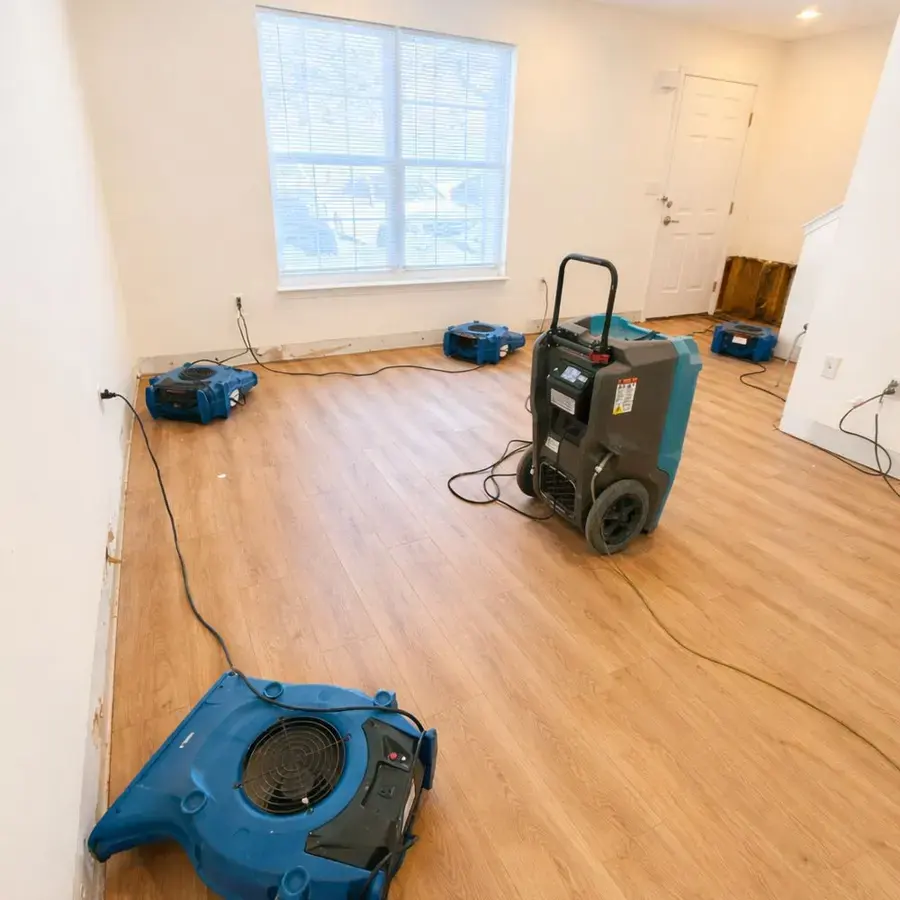
A concrete slab and block or masonry walls hold moisture for a long time. Dehumidifiers pull moisture from the air, and air movers carry dry air across wet surfaces and into wall bays.
Moisture readings are taken at the start and at every visit, and the drying follows the IICRC S500 standard. Equipment stays until the readings match a dry reference.
Wet materials left alone can start to grow mold within 24 to 48 hours, so time matters. Finished basements hide moisture behind paneling and baseboards, so those areas are opened where readings show a problem.
Elsmere housing is mostly tract homes and row houses, and row houses share walls. Moisture can travel to a neighbor's side, which is why readings are taken beyond the visibly wet area.
Checking flood risk and planning ahead
The Town Code Enforcement Office gives out flood zone information on request, including whether a property is in the Special Flood Hazard Area. That is a useful first call for a homeowner who wants to know the risk before the next storm.
The Town of Elsmere contracted KCI in 2022 for a stormwater project to address drainage issues causing ponding, flooding and erosion damage in many parts of town. Progress on that work may change how some streets drain.
The Elsmere water damage page lists every service available in town.
Insurance matters too. Flood coverage is usually a separate policy from a standard homeowner policy, so the wording is worth reading before a storm, not after.
- Ask the Code Enforcement Office about flood zone status for the property.
- Keep valuables and key papers off the basement floor.
- Check that downspouts and yard grading send water away from the house.
- Know where the shutoffs and the electrical panel are.
Questions
Is creek water in a basement considered contaminated?
Yes. Creek and drain water carry soil, debris and bacteria, so porous materials that soaked it are usually removed and surfaces are cleaned and treated.
What was the flood of record on Little Mill Creek?
July 5, 1989, when the creek at Elsmere peaked at 4,400 cubic feet per second and damaged mostly homes in the Elsmere area.
Did the flood reduction project stop basement flooding in Elsmere?
It deepened and widened the lower creek, finishing its phases in 2007 and 2015. Storms in August 2018 and the August 2024 flood warning show that flooding is still a concern.
Where can an Elsmere homeowner learn about flood zone status?
The Town Code Enforcement Office gives out flood zone information on request, including whether a property is in the Special Flood Hazard Area.
How long does basement drying take?
It depends on how much water came in and what it soaked. The crew follows moisture readings, and equipment stays until the slab and walls read dry.