Structural Drying and Dehumidification in New Castle, DE
Surfaces feel dry long before framing, subfloor and masonry are. The drying team runs air movers and dehumidifiers until readings sit within 2 to 4 points of a dry reference.
(888) 442-3602Get structural drying started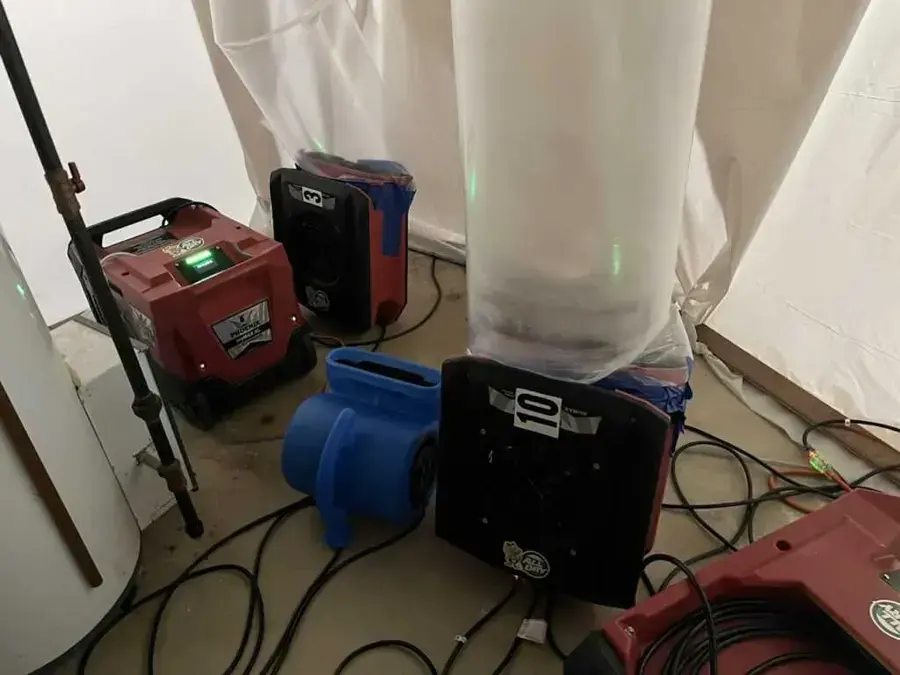
Structural Drying and Dehumidification at a glance
First steps for structural drying and dehumidification in New Castle
Keep doors closed
Closed rooms let dehumidifiers work on a smaller volume of air.
Leave equipment running
Turning it off at night slows drying and resets progress.
Run the air conditioning
In summer, AC helps pull humidity out of the house.
Keep belongings off wet floors
Boxes and rugs trap water under them.
Structural drying is the part of the job nobody sees and the part that decides whether the damage comes back. Water hides in framing, subfloor, slab and masonry long after carpet and drywall feel dry to the touch.
How the drying plan is set
The mitigation team sizes equipment to the room, the materials and the class of loss, not to a rule of thumb.
- Class 1 to 4 sets how much equipment a room needs
- Air movers are set to the evaporation load of the wet surfaces
- LGR dehumidifiers pull water out of the air in most rooms
- Desiccant dehumidifiers dry dense materials and cool basements
What does structural drying and dehumidification cost in New Castle, DE?
In New Castle, DE, structural drying typically runs $1,000 to $8,000, depending on the number of rooms, the class of loss and how many days the equipment runs.
One or two rooms
$1,000 to $2,500- Air movers and LGR
- Daily readings
- Three to four days
Basement or floor
$2,500 to $5,500- Desiccant on slab
- Wall cavity drying
- Psychrometric logs
Large or dense materials
$4,500 to $8,000- Plaster and brick
- Extended equipment
- Multiple zones
Ranges are typical, not a quote: category of water, square footage, material class and how fast drying started move the number most. Run the New Castle water damage cost calculator for a closer range.
The structural drying and dehumidification process in New Castle, step by step
- 1
Moisture map
Every wet material is mapped and a dry reference reading is set.
- 2
Set equipment
Air movers and dehumidifiers are sized to each room.
- 3
Log daily
Readings, temperature and humidity are logged every day.
- 4
Confirm dry
Equipment comes out when readings reach the dry goal.
Reading to dry, not drying to a schedule
A dry reference reading is taken on unaffected material in the same building. Wet materials are measured every day and logged with temperature and humidity in psychrometric logs. Equipment leaves when wet materials sit within 2 to 4 points of that reference.
Humid summers and dense materials
New Castle summers are humid, which slows evaporation unless the air is dried. Brick cellars, plaster and slabs release water slowly. The EPA indoor air quality page explains why indoor humidity matters, and the NWS Mount Holly office tracks the humidity and storms that shape drying here.
Structural drying and dehumidification across New Castle and New Castle County
The New Castle restoration crew covers ZIP 19720, 19721 and 19726, from the Historic District and The Strand to Castle Hills, Collins Park, Swanwyck Estates, Wilmington Manor and the Route 13 corridor.
Nearby coverage reaches Wilmington, Elsmere, Newark, Bear, Delaware City and the Maryland and Pennsylvania line towns.
Related water damage services in New Castle
Structural Drying and Dehumidification questions in New Castle, DE
Still dealing with structural drying and dehumidification?
Hidden water in framing and slab is what brings damage back. The drying team sets up at any hour.
Why does the equipment stay after the floor feels dry?
Framing, subfloor and slab hold water after the surface dries. Readings decide when equipment leaves.
What is a dry reference?
A reading on unaffected material in the same building. Wet materials are dried until they read within 2 to 4 points of it.
Why is the equipment so loud?
Air movers move a lot of air across wet surfaces. The noise is part of drying faster.
What is the difference between LGR and desiccant dehumidifiers?
LGR units work well in warm rooms. Desiccant units dry dense materials and cool basements better.
How much does the equipment add to the power bill?
Each unit uses about as much as a household appliance. The drying team can share equipment counts for the claim.
What is IICRC S500?
It is the industry drying standard for water damage restoration, covering categories, classes, equipment and when a structure counts as dry.
Still damp in New Castle? Get the drying started today.
The crew maps moisture, sets equipment to the room and logs readings until it is truly dry.
New Castle Water Damage Restoration · New Castle, DE