Basement Flooding Cleanup in Newark, DE
Heavy rain on creeks and storm sewers can send water into Newark basements. The crew pumps it out and dries the slab and walls until readings say dry, with notes ready for owners, tenants and insurers.
(888) 442-3602Call for a Newark basement pump-out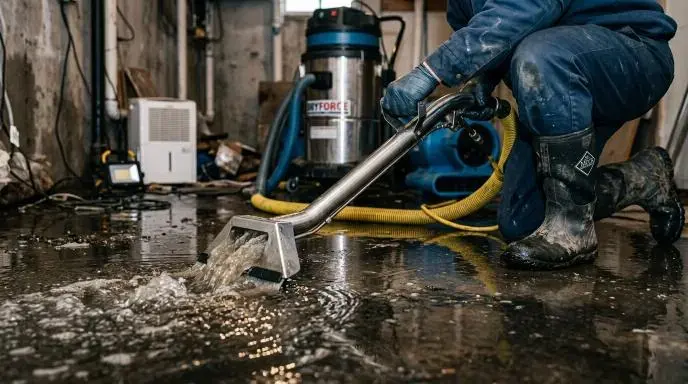
Basement Flooding Cleanup at a glance
First steps for basement flooding cleanup in Newark
Treat the panel with care
If water is near outlets or the panel, stay out and flip breakers only from dry footing.
Pause plumbing use
Once sewage appears, no flushing, showering or laundry.
Carry belongings up
Haul boxes, rugs and electronics to a higher floor before the water spreads.
Record how high it rose
Photograph wide and close, then mark the water line on the walls.
A Newark basement can take water from the creek side, from the storm sewer and from a pit that quits. Each finished layer, from carpet to wall bottoms, holds that water against the concrete.
Why Newark basements take on water
Newark spans two regions, with hills to the north and west and flat land to the south and east, so water runs downhill to the low blocks. The city publishes a Drainage Concerns list that names Rahway Drive, Creek Road, Curtis Lane and Shull Drive, and it advises parking cars on higher ground when storms are predicted. On March 23, 2024, 2.6 inches of rain pushed the Christina River to 12.1 feet, above its 11 foot flood stage.
What does basement flooding cleanup cost in Newark, DE?
Basement flooding cleanup in Newark, DE usually costs $2,000 to $18,000, from a tidy clean-water leak in bare concrete up to a finished room soaked by sewage or creek water.
Bare concrete, clean water
$2,000 to $4,500- Water pumped and extracted
- Slab and block dried
- Readings each day
Finished basement
$4,500 to $11,000- Carpet and pad taken out
- Lower drywall opened
- Framing dried
Sewage or floodwater
$8,000 to $18,000- Barriers and protective gear
- Porous finishes removed
- Antimicrobial treatment
Ranges are typical, not a quote: category of water, square footage, material class and how fast drying started move the number most. Run the water damage cost calculator for a closer range.
The basement flooding cleanup process in Newark, step by step
- 1
Pump down the water
Submersible pumps lower the level, then wand tools clear what remains on the floor.
- 2
Trace the wet walls
A thermal camera and pinless meters reveal how far moisture climbed in each wall.
- 3
Remove and sanitize
Ruined pad and wall board come out, and surfaces get antimicrobial treatment.
- 4
Dry until it reads dry
Dehumidifiers and air movers stay on until slab and framing read dry.
Sewer and creek water count as Category 3
When creek water or a sewer backup reaches a basement, it is handled as Category 3.
- Porous finishes the water reached, such as carpet and pad, are removed behind containment
- Wall board is cut just above the wet line shown by meters
- Hard surfaces are sanitized with an EPA-registered product before equipment is set
- Water from a supply pipe or a tank that is caught early can often stay and be dried in place
Getting slab and block dry
Concrete and block release moisture slowly, so the crew runs LGR and desiccant dehumidifiers beside air movers and records readings daily until slab and framing match a dry sample. See structural drying for the readings, or tidal and river flood cleanup when the creek was the source.
Where an owner and tenants share a building, the notes record which room took water, which helps each side sort out the claim.
Basement flooding cleanup across Newark and nearby towns
The Newark restoration crew covers ZIP 19711, 19713 and 19702, from Stafford and Barksdale Estates through Abbotsford and Country Place to the neighborhoods along Casho Mill Road and Chestnut Hill Road.
The same service nearby: basement flooding cleanup in New Castle, Elkton, Elsmere.
Related water damage services in Newark
Basement Flooding Cleanup questions in Newark, DE
Still dealing with basement flooding cleanup?
Each day water stays in a Newark basement, it travels further into block, framing and finishes. The basement crew pumps at any hour.
What makes a Newark basement take water during heavy rain?
The storm sewers can fill faster than they drain, as on June 5, 2016, and creeks rise with the same rain. Water enters through drains, walls and window wells.
Can I touch basement floodwater?
Assume it is hazardous. Water from a creek or a sewer is classed Category 3, which means protective equipment and antimicrobial treatment.
How many days until a Newark basement is dry?
Most land between four and seven days, though block walls, cool concrete and sewage-tainted water stretch that, and meter readings set the end point.
Is a flooded basement an insurance claim?
Coverage depends on the cause. Burst pipes are commonly covered, while creek flooding and sewer backup usually require flood insurance or a sewer backup endorsement. Your own insurer decides.
Is it safe to run the furnace afterward?
Have a qualified technician inspect any furnace, boiler or water heater the water reached before it is switched on again. Replacing one needs a city building permit.
Can a landlord and tenant both file?
Both may have a stake, since the owner insures the structure and the tenant insures belongings. The crew's photos and logs help each side show the loss.
Flooded basement in Newark? Call before the walls wick it up.
Pumps come first, then anything ruined is hauled out and equipment goes onto slab and block.
New Castle Water Damage Restoration · New Castle, DE